Pond Water Table Problems: Causes & Solutions
Water is disappearing from your pond faster than it should. The edges are soggy even when it hasn't rained. Your liner is buckling. Water levels keep dropping to the same point and stopping. These aren't random inconveniences, they're symptoms of an underlying problem, and in many cases, a high or shifting water table is the cause.
Pond water table problems are more common than most property owners realize, and they're frequently misdiagnosed as liner failures or simple leaks. Understanding what's actually happening below the surface is the first step toward a lasting fix, and toward a healthy, balanced pond ecosystem.
What Is a Water Table — and Why Does It Matter for Ponds?
The water table is the upper boundary of the zone of saturation in the ground, the level below which soil and rock are fully saturated with groundwater. It isn't fixed. It rises after heavy rain, rises in spring as snowmelt recharges it, and drops during drought.
For ponds, this matters enormously. A pond sitting in an area with a high water table can experience groundwater seepage into the pond (raising water levels unpredictably) or groundwater pressure pushing against the pond's liner from underneath (causing buckling or displacement). Conversely, in areas where the water table drops seasonally, ponds can lose water into the surrounding soil faster than evaporation alone would explain.
The challenge is that water table problems often look like other pond problems. That's why correct diagnosis matters before any repairs are made.
Diagnosing Pond Water Loss and Leaks
A dropping water level is one of the most common concerns among pond owners, and one of the most misunderstood. Before assuming a liner failure or a significant leak, it's worth working through a systematic troubleshooting process.
Step 1: Rule out normal evaporation
Slow, gradual water level reduction is normal, especially in summer. Ponds lose water to evaporation, particularly if they include a waterfall or fountain that increases surface agitation. A rapid or sudden drop, however, is a different signal.
Step 2: Identify where the water level stops
When pond water levels drop and then stabilize at a specific point, that stopping point is your best clue. The water surface will tend to equalize at the location of the breach, whether that's a low edge, a crack in a waterfall structure, or a gap in the liner seam.
Step 3: Check for splash leaks at waterfalls and streams
Water splashing out of a waterfall or stream is a surprisingly common source of loss, and it's easily overlooked. Trace the watercourse from top to bottom, watching for wet areas alongside (not underneath) the structure. A small stone adjustment can often solve the problem entirely.
Step 4: Inspect the liner
If you've ruled out splash leaks and evaporation, a hole or compromised seam in the pond liner is the next most likely culprit. Small leaks can often be patched, but larger tears or liner displacement caused by groundwater pressure may require a full liner replacement. When inspecting, pay particular attention to liner edges, if one section sits lower than the surrounding grade, water will find its way out through that low point.
Managing a High Water Table
Sites with a naturally high water table present both challenges and opportunities for pond management. On the positive side, a high water table can supply a consistent groundwater source that helps maintain pond water levels during dry periods. On the challenging side, it creates hydrostatic pressure that can heave liners, destabilize earthen dam structures, and make it difficult to maintain stable water levels.
Signs of high water table impact on your pond
-
Liner buckling, wrinkling, or floating, hydrostatic pressure from below is pushing the liner up
-
Consistently soggy ground surrounding the pond, even during dry weather
-
Water levels that fluctuate with rainfall in ways that exceed normal surface runoff
-
Seepage visible around the edges or base of a dam
What you can do
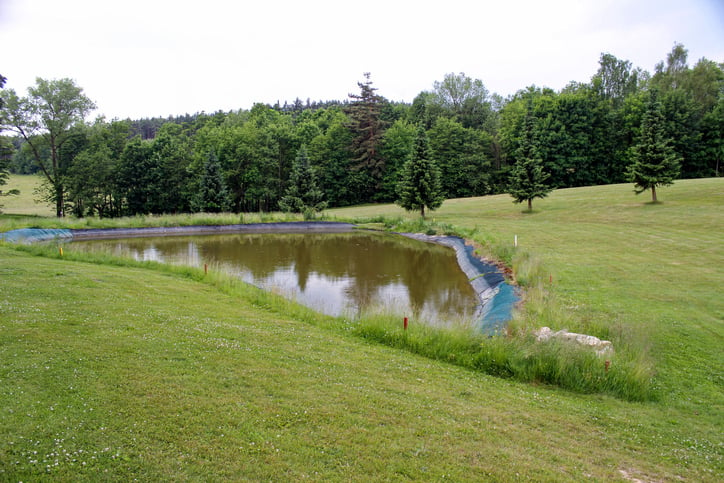
For ponds with liner systems, drainage below the liner can relieve hydrostatic pressure and prevent displacement. French drains or perforated pipe systems installed beneath the liner during construction are the most effective long-term solution. Spillways are also worth considering where groundwater inputs are significant, directing excess water away from the pond structure reduces pressure on dams and edges.
For earthen ponds in high water table areas, compaction and clay content of the dam and pond bottom become critical. A well-designed earthen pond takes advantage of the water table rather than fighting it, but only if the pond was engineered with local hydrology in mind.
Troubleshooting Pond Construction and Design Problems
Many water table problems aren't really water table problems at all, they're design or construction issues that interact badly with the local hydrology. Common culprits include:
-
Low edge points: Pond edges that sit below grade allow water to escape every time the water level rises. Lifting and shimming the liner edge, or adding material beneath it, corrects this.
-
Improperly sealed penetrations: Plumbing connections, skimmer boxes, and biological filter housings are common leak points. Any penetration through the liner needs a properly installed bulkhead fitting.
-
Cracked concrete features: Concrete waterfalls or streams can crack and wick water away from the pond. Concrete is porous by nature, water absorbed into the structure can be lost to evaporation from the concrete surface rather than returning to the pond.
-
Undersized spillways: If a pond receives more water than it can hold, from groundwater inflow, springs, or surface runoff, an inadequate spillway can lead to water loss over unprotected sections of the dam or bank.
Protecting Your Pond Ecosystem Through Water Stability
Water level instability doesn't just create a management headache, it disrupts the pond ecosystem. Fish and aquatic plants depend on stable conditions. Rapid water level changes can expose fish to temperature swings and oxygen depletion, stress aquatic plants, and allow debris to accumulate in areas that should stay submerged.
If your pond regularly experiences water level swings, it's worth evaluating your aeration and filtration systems as part of any remediation plan. A properly sized aerator maintains dissolved oxygen even during low-water stress periods. Good filtration reduces the sludge buildup that accelerates when water chemistry becomes unstable.
A balanced ecosystem pond is more resilient to the challenges a high or shifting water table creates. The goal isn't just to stop the leak, it's to create conditions where your pond can thrive long-term.
Not sure what's causing your pond's water loss?
Jones Lake Management's team of pond and lake professionals has diagnosed water table challenges across dozens of properties. Whether you're managing a backyard water feature, a community amenity pond, or a commercial lake, we can help you identify the problem and build a plan that works for your site.
Contact us to schedule a site assessment.
About Jones Lake Management
Since 1949, Jones Lake Management has been a trusted leader in lake and pond management, delivering scientifically backed solutions to create and maintain healthy, balanced, and beautiful waterbodies throughout the Midwest, Southeast and Texas. Our expert team offers a full range of services, including fish stocking, fisheries management, water quality monitoring, algae and aquatic weed control, aeration solutions, erosion control, invasive species management, hydraulic dredging, and more. Whether you manage a private lake, an HOA stormwater pond, a golf course water feature, or a municipal waterway, we provide customized solutions to ensure your waterbody remains healthy, functional, and thriving.
Discover our trusted lake and pond management partners nationwide—bringing expertise and care to communities across the country. From Aqua Services and Pond Lake Management in the Southeast, to Water and Wetland in New England, Savin Lake Services in Michigan, Wisconsin Lake and Pond Resource in Wisconsin, Aquatics Associates in Colorado, and Johnson Lake Management and Aquatic Features in Texas, each partner delivers premier service tailored to their region. Visit us at www.joneslakemanagement.com